

BRONISŁAW PABICH
Wyższa Szkoła Nauk Pedgogicznych Warszawa, wieliczka
Spatial geometry continues to conceal various secrets from its researchers. Sometimes, chance observations confirmed by the reading of metric quantities lead to discoveries in 3D geometry. Our students, unfamiliar with stereometry, can experience delightful moments of discovering facts that even their teachers are unaware of. Further discoveries stem from the search for analogies to already known knowledge.
Here’s an example that might confirm this thesis.
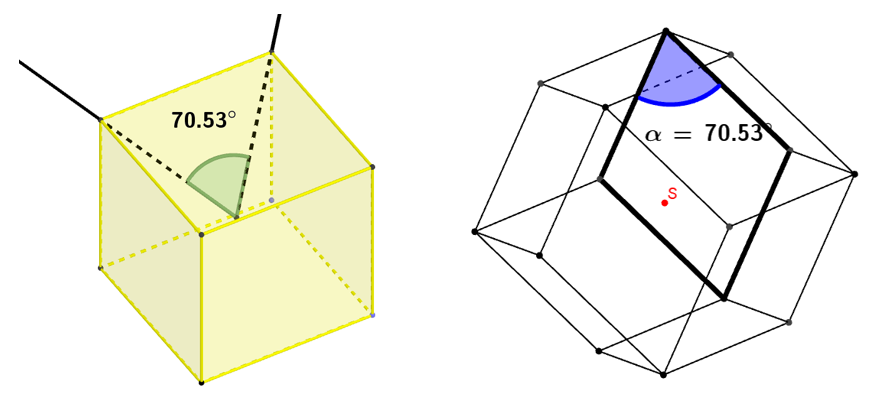
Let the students measure the angle α at which we see the edge of a cube from its center, and then let’s construct 12 congruent rhombuses whose acute angle has exactly this measure α.
Then let the students assemble these 12 rhombuses into a convex polyhedron. Experts in 3D geometry know that this will produce the rhombic dodecahedron – one of the well-known rhombic hexahedrons.
Let’s challenge students to continue their discoveries by asking, “What should we do next?”
Students might solve the same problem with other regular polyhedra and discover other rhombohedra.
• Which platonic polyhedra will they use for this purpose?
• What will they get from them?
The author of this talk will show the further history of this small 3D discovery. He will also show the corresponding 3D-printed models.